What is an Embedding?
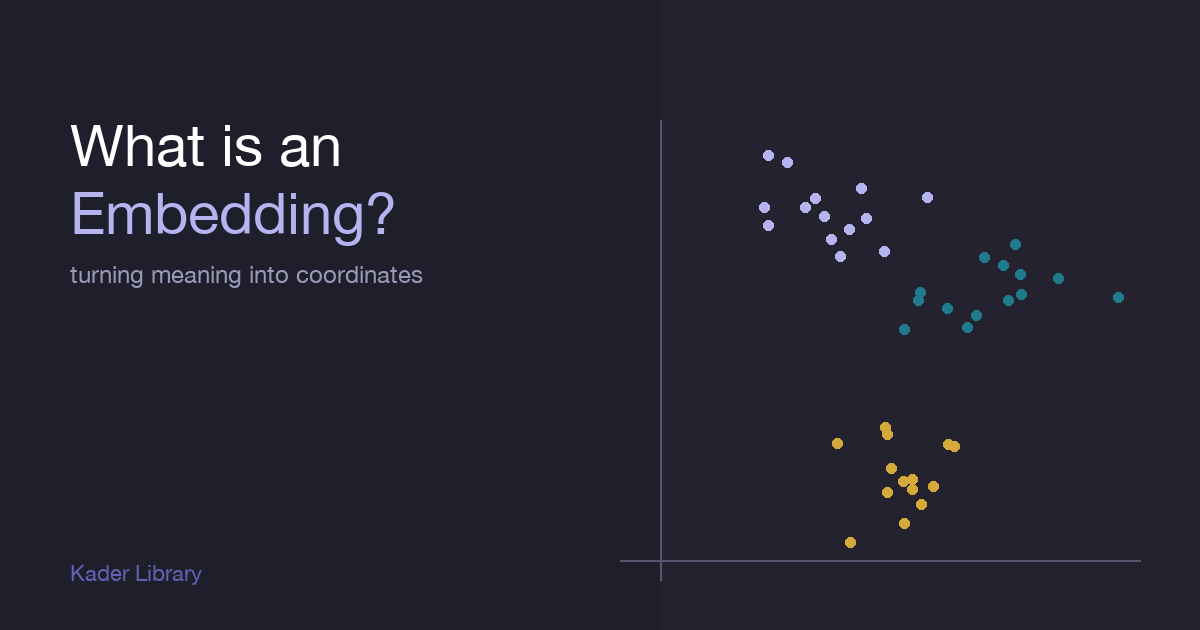
A computer can’t compare two words the way you do. It has no sense of “king and queen feel related.” So we give it one — we turn every word into a list of numbers, place it as a point in space, and arrange that space so things that mean similar things land near each other. That list of numbers is an embedding.
The short version
An embedding is a vector — a fixed-length list of numbers — that represents a piece of data (a word, a sentence, an image, a user) as a point in space. The whole trick is that the space is arranged so distance means similarity: close points are alike, far points are not.
Key idea: An embedding turns “what does this mean?” into “where does this sit?” — and once meaning is a location, similarity is just distance.
Why we can’t just use the words
Computers store the word cat as a number (an ID), and dog as another. But those IDs are arbitrary — ID 4821 isn’t “closer” to ID 4822 in any meaningful way. There’s no math you can do on raw word-IDs that respects meaning.
Embeddings fix this. Instead of one arbitrary ID, each word gets a few hundred numbers, learned so that the geometry carries meaning. Now cat and dog end up near each other, while cat and bulldozer end up far apart — and that’s something a machine can actually compute with.
Distance is the whole point
Once words are points, you measure similarity with the dot product or cosine similarity — the same vector operations you already know. Try it: drag the two vectors and watch how “aligned” they are. Two embeddings pointing the same way = similar meaning.
The famous example: take the embedding for king, subtract man, add woman — and you land almost exactly on queen. Meaning became arithmetic.
Where embeddings come from
Nobody hand-writes these numbers. A model learns them by reading enormous amounts of text and nudging each word’s vector based on the company it keeps — words that appear in similar contexts get pulled together. Word2Vec and GloVe did this for single words; modern transformer models produce contextual embeddings, where the same word gets a different vector depending on the sentence around it.
The dimension count (e.g. 384, 768, 1536) is just how many numbers each point has. More dimensions = more room to separate fine distinctions, at the cost of compute and memory.
Why it matters
Embeddings are the quiet engine under most of modern AI:
- Search & RAG — find documents whose embedding is closest to your question’s embedding.
- Recommenders — users and items as nearby points; recommend what’s close.
- Clustering & dedup — group by proximity in embedding space.
- LLMs — the very first thing a transformer does is embed your tokens before any reasoning happens.
If you understand embeddings, you understand the layer where raw data becomes something a model can think about.